Dynamic Skill Theory
The “Dynamic Skill Theory,” developed by Kurt W. Fischer (Harvard University) in 1980, essentially examines the parallel development of individual, initially fragmented functions and skills in dynamic interaction with their environment, and considers personal development across various degrees of differentiation and levels of integration.
Based on classical developmental theories, children and later adults develop competencies in similar ways during specific developmental cycles, such that personal development occurs as a kind of differentiation of biologically innate abilities, with the corresponding interaction with the environment determining which competencies are developed into sustainable functional skills. Despite potentially similar basic predispositions, each development proceeds individually, and thus the mature or less mature self-system reflects the interactive dynamics arising from basic predisposition and responses from the immediate environment. Fischer’s thesis is that systems and competencies develop through the combination and interaction of stable states (such as biological parameters) with a wide variety of environmental conditions (significant others, culture, etc.). According to Fischer, personal competencies initially develop in fragmented strands of a network that can potentially be integrated across different levels of maturity.
The 13 levels and 4 stages of development in Fischer's theory of dynamic competencies
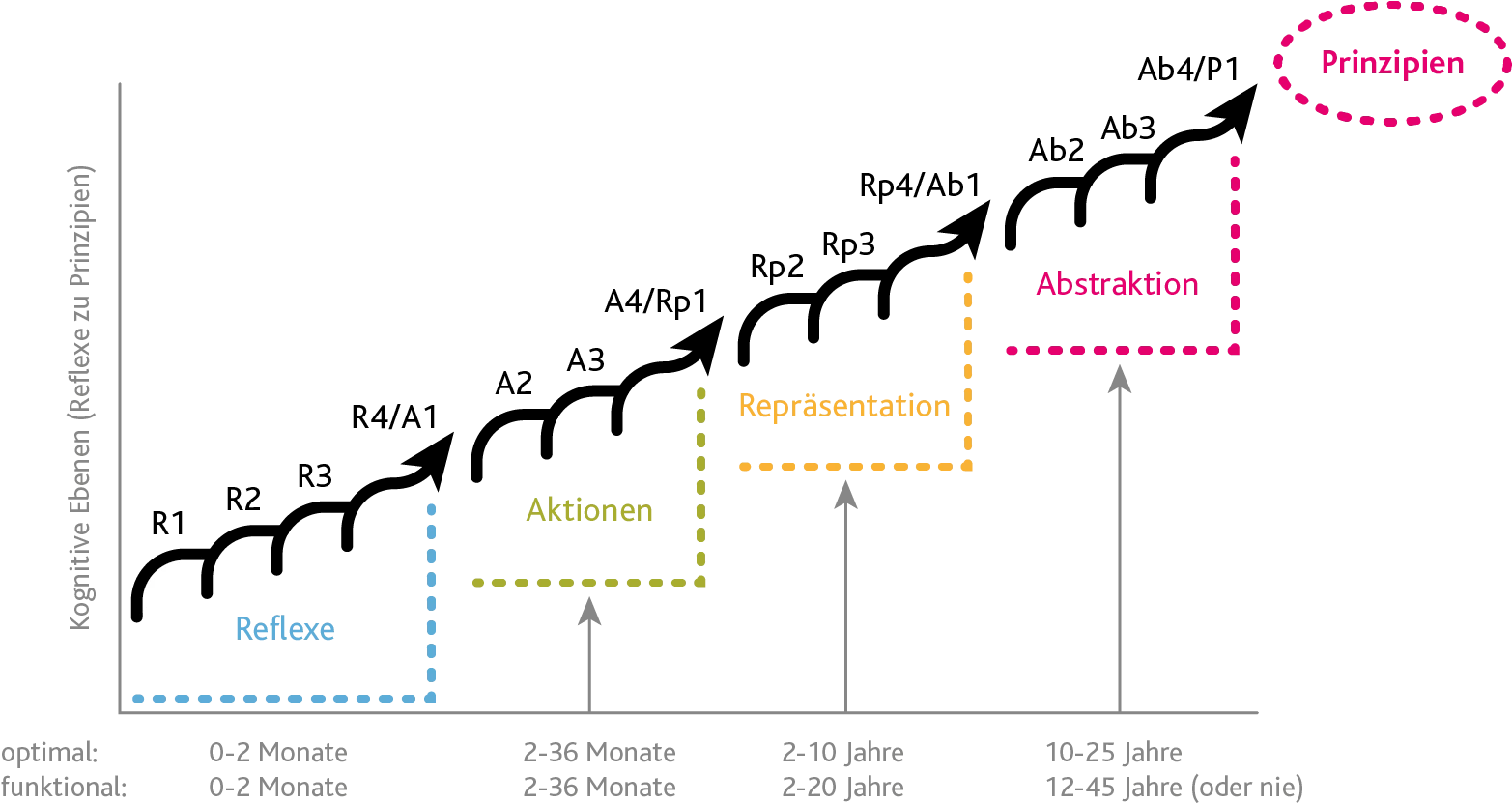
The theory of dynamic competencies—like Erikson’s eight-stage theory—describes development in distinct stages; however, unlike other theories, it places particular emphasis on the fragmented yet parallel development of various competencies that are typically considered independently of one another. Thus, according to Fischer, development does not follow a classic, singular ladder of stages, as described by Piaget, for example, but rather proceeds dynamically and non-linearly.
Fischer’s theory posits four central stages of development. The first stage describes the fragmented form of information processing, that is, a natural binary division into positive and negative affective biases. The next, second stage represents a basic level of initial integration, which manifests itself in the ability to switch independently between positive and negative affective biases. The third stage involves a form of partial integration, and the fourth stage involves stable integration. Within these four central stages, there are varying levels of representational capacity and abstract thinking ability, which can be examined within the framework of a total of twelve different competencies and four additional levels of abstraction.